


You've probably tried melatonin. Maybe it worked for a night or two, then stopped. Or you woke up the next morning feeling like you'd slept through a fog — groggy, heavy, not quite yourself. Some people report unusually vivid dreams. Others find the timing finicky: too early and it doesn't kick in, too late and you've missed your window.
Melatonin dominates the natural sleep conversation, but it isn't the whole conversation. There's a growing group of adults — including people managing stress, hormonal shifts, or just plain overactive minds — who are quietly looking for something else. This post is for them.
What follows isn't a list of miracle cures. It's an honest map of the non-melatonin options with the most documented use, what each one is realistically designed to help with, and what you should understand before you try any of them.
Why Melatonin Doesn't Work for Everyone
Melatonin is a hormone your body already makes — it signals that it's dark and time to sleep, not that you're tired. That distinction matters. If your problem is that your circadian rhythm is off (jet lag, shift work, irregular schedules), melatonin can genuinely help. But if your problem is anxiety at bedtime, racing thoughts, physical tension, or simply an inability to stay asleep once you get there, melatonin isn't addressing the root issue.
It's also worth knowing that the research on melatonin dosing is more nuanced than most supplement labels suggest. Many products contain doses far higher than what studies have used, which may explain the morning grogginess some people experience. None of this makes melatonin a bad option — it just means it's not a universal one.
The Alternatives Worth Knowing About
Magnesium
Magnesium is probably the most broadly useful non-melatonin option, and it works through a completely different mechanism. It plays a role in regulating the nervous system and supports the activity of GABA, an inhibitory neurotransmitter that helps quiet neural activity — the biological equivalent of turning down the volume on a busy mind. Research published on PubMed has explored magnesium's relationship with sleep quality, particularly in older adults and those with low dietary magnesium intake.
Magnesium glycinate and magnesium threonate are the forms most commonly associated with sleep and relaxation support, as they're considered more bioavailable than magnesium oxide. It won't knock you out — but if physical restlessness or a wired nervous system is keeping you up, it may take the edge off in a way melatonin simply can't.
Valerian Root
Valerian has been used for centuries as a calming herb, and it remains one of the most studied botanicals for sleep. Like magnesium, it's thought to interact with GABA pathways, though the exact mechanisms aren't fully settled in the research. It's typically taken as a capsule or tea about an hour before bed.
The honest caveat: the research on valerian is mixed. Some studies show meaningful improvements in sleep onset and quality; others show effects closer to placebo. What seems consistent is that valerian works better over time than as a single-night fix, and it tends to be more effective for people whose sleep problems are tied to anxiety or tension rather than a disrupted body clock. It also has a distinctly earthy smell — something to know before you open the capsule.
L-Theanine
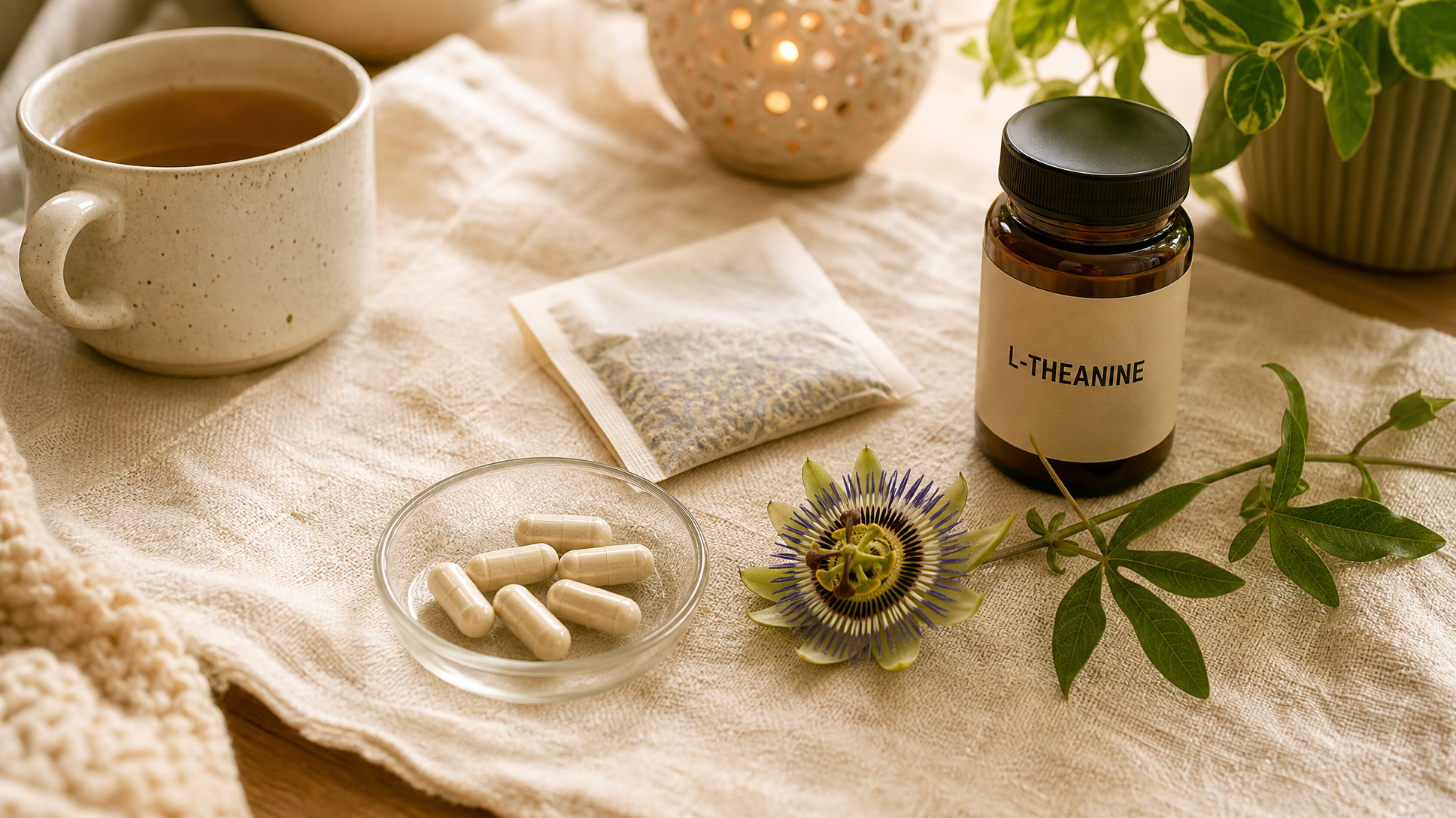
L-theanine is an amino acid found naturally in tea leaves, and it has an unusual quality: it promotes a state of calm alertness without sedation. That sounds counterintuitive for a sleep aid, but the logic holds. Many people can't sleep not because they aren't tired, but because their mind won't stop. L-theanine is thought to support alpha brain wave activity — the kind associated with a relaxed, unfocused state — which can make the transition to sleep easier without making you feel drugged.
It's also one of the better-tolerated options in this category, with a relatively clean safety profile. You'll often find it paired with magnesium or GABA in combination sleep formulas, which is a reasonable pairing for people dealing with both physical and mental restlessness at bedtime.
Herbal Blends: Passionflower, Ashwagandha, and Lemon Balm
These three herbs show up frequently in sleep and stress formulas, and each has a slightly different profile.
Passionflower has been studied for its calming effects and is sometimes used for anxiety-related sleep disruption. Ashwagandha is an adaptogen — meaning it's thought to help the body manage stress responses over time — and some research suggests it may support sleep quality as a downstream effect of lowering cortisol. Lemon balm is a mild herb often combined with valerian; on its own, it's more of a gentle relaxant than a sleep aid, but it can take the edge off an anxious evening.
None of these are sedatives in the pharmaceutical sense. Think of them as tools for creating the right internal conditions for sleep, rather than forcing it.
GABA Supplements
GABA (gamma-aminobutyric acid) is the brain's primary inhibitory neurotransmitter, and it's available as a standalone supplement. The controversy around it is whether oral GABA can actually cross the blood-brain barrier in meaningful amounts — the scientific jury is still out. Some people report noticeable relaxation effects; others don't. If you're curious, it's generally well-tolerated, but go in with realistic expectations and understand that the mechanism isn't as straightforward as the label might imply.
The Option Everyone Underestimates: Sleep Hygiene Supports
This isn't a lecture about screens before bed. It's a practical acknowledgment that physical comfort and environmental factors are genuine sleep interventions — and often more effective than any supplement when they're the actual problem.
Light management (blackout curtains, a well-fitted sleep mask), temperature regulation, white noise or earplugs, and consistent wake times all have solid evidence behind them. The CDC recognizes sleep hygiene as a foundational component of healthy sleep. A sleep mask that actually stays put, for instance, can make a meaningful difference for someone sleeping in a light-polluted room — and it costs less than a month's supply of supplements.
If you're curious about choosing the right sleep mask for your specific sleeping style, this breakdown on flat mask vs. contoured cup vs. headband style is worth a read before you buy.
How to Think About Choosing One
The right starting point depends on what's actually disrupting your sleep. A few honest questions to ask yourself:
- Is it your mind that won't quiet down? L-theanine or magnesium glycinate are reasonable first tries.
- Is it physical tension or restlessness? Magnesium, particularly taken in the evening, may help more than a calming herb.
- Is it anxiety or stress that follows you to bed? Ashwagandha (taken consistently over weeks) or passionflower may be worth exploring.
- Is it your sleep environment? No supplement fixes a room that's too bright, too loud, or too warm. Start there.
- Is it a timing or rhythm issue? This is where melatonin actually earns its place — and where the other options listed here won't do much.
It's also worth saying plainly: if you've had persistent sleep problems for weeks, or if poor sleep is affecting your daily functioning significantly, talking to a healthcare provider is the right move before experimenting with supplements. Chronic insomnia can have underlying causes — pain, sleep apnea, anxiety disorders, medication side effects — that no herbal blend will address.
A Note on Combination Products
Many sleep supplements on the market combine several of these ingredients — magnesium with L-theanine, valerian with lemon balm, ashwagandha with GABA. This isn't inherently a problem, and some combinations are genuinely well-thought-out. But it does make it harder to know what's actually working if something helps (or doesn't). If you're starting fresh, trying one ingredient at a time for a couple of weeks gives you cleaner information about what your body responds to.
Ready to explore what's available? Browse the sleep and wellness options at Medistoreweb — free US shipping, secure checkout, and 24/7 support if you have questions about what you're looking at.
Frequently Asked Questions
Can I take magnesium and L-theanine together?
Many people do combine these two, and they're often found together in sleep formulas for that reason. They work through different pathways — magnesium supports nervous system regulation while L-theanine promotes a calm mental state — so they're not redundant. That said, it's always worth checking with a pharmacist or your doctor if you're on any medications or have underlying health conditions before adding new supplements.
How long does valerian root take to work?
Valerian is generally considered more effective with consistent use over a couple of weeks than as a one-night solution. Some people notice a mild calming effect on the first night, but the more meaningful benefits tend to build over time. If you try it once and feel nothing, that doesn't necessarily mean it won't work for you — give it a fair run before drawing conclusions.
Are natural sleep aids safe to take every night?
That depends on the specific supplement and your individual health situation, and it's genuinely a question for your healthcare provider rather than a general article. What's true as a general principle: most of the options discussed here (magnesium, L-theanine, herbal blends) are not habit-forming in the way that pharmaceutical sleep aids can be. But long-term daily use of any supplement warrants a conversation with a doctor, especially if underlying sleep issues haven't been properly evaluated.
What's the difference between a sleep aid and a sedative?
Most natural sleep aids in this category are not sedatives — they don't force sleep by suppressing the central nervous system the way prescription or OTC sleeping pills do. Instead, they work by reducing the barriers to sleep: calming an overactive nervous system, easing physical tension, or supporting the body's own wind-down processes. That's why they tend to feel subtler and why they work better for some types of sleep problems than others.