


Most people don't think about supplemental oxygen until they need it—and then they're suddenly staring at two very different types of products, unsure which one actually fits their situation. A portable canister sitting on a gym shelf looks nothing like a coil of oxygen tubing, and the gap between them isn't just aesthetic. They serve genuinely different needs, and buying the wrong one is an easy mistake to make.
Here's a straightforward way to think through it.
What Problem Are You Actually Trying to Solve?
Start here, because this question does most of the work. Supplemental oxygen is used in a few distinct situations, and each one tends to point toward a different type of product.
Altitude and travel discomfort. If you're heading to a high-altitude destination—a ski trip, a hike above the treeline, or a visit to a city like Denver or Santa Fe—your body is working harder to pull oxygen from thinner air. The symptoms (headache, fatigue, lightheadedness) are real, and a portable canister can offer quick, on-demand relief. This is a short-burst, situational need. You're not using it continuously; you're reaching for a few inhalations when you feel the effects.
Aerobic performance and recovery. Some athletes and active individuals use supplemental oxygen between intense training sets or after a hard workout to help the body recover. Again, this is intermittent use—not a continuous flow, not a prescription setup. A canister you can stash in a gym bag makes sense here.
Poor air quality days. Wildfire smoke, high-pollution urban environments, or seasonal air quality dips can make breathing feel labored, especially for people who are already sensitive. A portable canister can help in these moments, though it's worth noting this is supportive use, not a medical treatment.
Home-based respiratory support. This is a different category entirely. If someone in your household uses a home oxygen concentrator—prescribed by a doctor for a chronic condition—they need reliable tubing to connect the concentrator to a nasal cannula. This isn't about carrying something in a backpack. It's about a stationary or semi-stationary setup that runs for extended periods at home.
The Portable Canister: When It Makes Sense
The Boost Oxygen Large Natural Aroma 10 Liter Canister is a clear example of the portable, on-demand category. It's a pressurized aluminum canister with a green top-mounted mask valve, compact enough to hold in one hand, and designed for use without any prescription or medical equipment. The label indicates it contains 95% pure oxygen and offers up to 200 one-second inhalations in the large size.
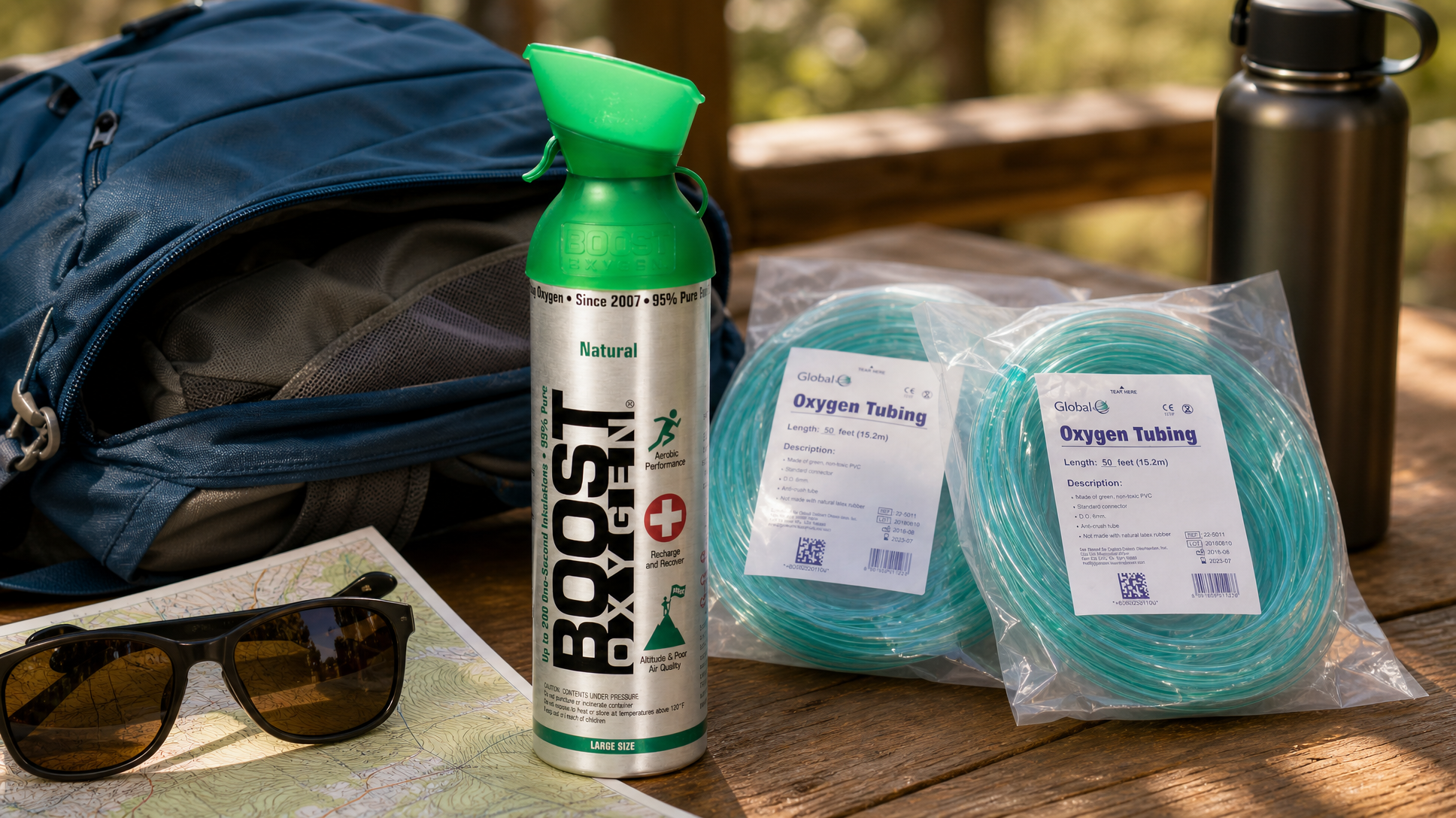
What makes this format practical for travel and activity is exactly what makes it unsuitable for extended home use: it's finite. A canister like this is built for short bursts—a few inhalations at a time—not continuous flow over hours. For altitude recovery mid-hike or a post-workout reset at the gym, that's perfectly adequate. For someone who needs supplemental oxygen while sleeping or throughout the day at home, it's not the right tool.
The natural aroma variant is unflavored, which matters if you're sensitive to scents or simply prefer a clean inhalation experience. Boost Oxygen has been around since 2007, and the large canister is a practical choice for anyone who wants something they can slip into a day bag or keep in a car for trips to higher elevations.
The Tubing Setup: When It Makes Sense
Oxygen tubing serves a completely different function. The Global Crush Resistant Oxygen Tubing – 50 ft, Green (2 Pack) is designed to connect a home oxygen concentrator to a nasal cannula, giving the user freedom to move around the house without being tethered to the machine. Each coil in this pack is 50 feet long—that's enough to move between rooms comfortably—and the tubing is made from green, non-toxic PVC with an anti-crush design so it doesn't kink under foot traffic or furniture.
This is a supply item, not a standalone oxygen source. The tubing itself doesn't contain oxygen; it's the conduit. If you or someone you're caring for has a home oxygen concentrator, having reliable, kink-resistant tubing in adequate length is genuinely important. A crushed or kinked tube disrupts flow, and running out of tubing mid-month is an avoidable frustration. The two-pack format makes sense for households that want a backup on hand or need to run tubing through different areas of the home.
It's also worth noting: home oxygen concentrators are typically prescribed medical devices. If someone in your home is on prescribed oxygen therapy, the tubing is a consumable that needs regular replacement—it's not a one-time purchase. Having extras matters.
Side by Side: The Practical Differences
| Portable Canister (Boost Oxygen) | Oxygen Tubing (Global 50 ft, 2 Pack) | |
|---|---|---|
| Use case | On-the-go, short-burst use | Home concentrator setups |
| Portability | High — fits in a bag | Low — stationary/room-to-room |
| Oxygen source | Self-contained canister | Connects to external concentrator |
| Prescription needed | No | Concentrator typically requires one; tubing itself does not |
| Duration of use | Intermittent inhalations | Extended continuous flow |
| Best for | Altitude, sports recovery, air quality | Chronic respiratory support at home |
The Mistake People Make
The most common misstep is treating these two categories as interchangeable—buying a portable canister expecting it to substitute for a home concentrator setup, or buying tubing without realizing it's useless without the concentrator it connects to. They're not competing products. They solve different problems for different people, and sometimes the same household needs both: a canister for the person who travels or hikes, and a tubing setup for a family member managing a chronic condition at home.
If you're not sure which situation applies to you, the simplest filter is this: is the oxygen need intermittent and situational, or is it ongoing and continuous? The answer almost always points you in the right direction.
For anyone managing chronic respiratory conditions, always follow the guidance of your physician before making changes to your oxygen therapy setup. Supplemental oxygen canisters like Boost Oxygen are not a medical treatment and are not intended to replace prescribed oxygen therapy.
Where to Go From Here
Not sure where to start? The Boost Oxygen Large Natural 10 Liter Canister is a solid choice for on-the-go use—altitude trips, post-workout recovery, or keeping one in the car for poor air quality days. If you're managing a home oxygen setup and need reliable tubing, the Global Crush Resistant Oxygen Tubing 50 ft 2 Pack gives you length, durability, and a backup in one order. Both ship free through medistoreweb.com—and if it's your first order, use code WELCOME5 for 5% off.
You can also browse the full Mobility, Safety & Daily Living collection if you're outfitting a home for someone with broader care needs, or check out this practical guide on stocking a home after a hospital discharge for a broader checklist of what to have on hand.
Frequently Asked Questions
Do I need a prescription to buy Boost Oxygen or oxygen tubing?
No prescription is required to purchase Boost Oxygen canisters or oxygen tubing. Boost Oxygen is an over-the-counter wellness product intended for recreational and supportive use. Oxygen tubing is a supply accessory—the tubing itself doesn't require a prescription, though the home oxygen concentrator it connects to typically does require one from a physician.
Can I use a portable oxygen canister instead of a home concentrator?
No—they're not interchangeable. A portable canister like Boost Oxygen is designed for short, intermittent inhalations and is not intended to replace a prescribed home oxygen concentrator. If you or a family member has a medical need for continuous supplemental oxygen, that requires a concentrator and a physician's guidance. A canister is for situational, on-demand use only.
How often should oxygen tubing be replaced for a home setup?
Oxygen tubing is a consumable that degrades over time—it can become brittle, discolored, or develop small cracks that affect flow. Most respiratory care guidelines recommend replacing tubing regularly, though your healthcare provider or equipment supplier can give you a specific schedule based on your usage. Having a backup pack on hand, like the Global 2 Pack, means you're never caught without a replacement.
Is Boost Oxygen useful for high-altitude travel?
Many people use portable oxygen canisters like Boost Oxygen when traveling to high-altitude locations to help manage symptoms like fatigue, headache, and lightheadedness that can come with thinner air. It's designed for short-burst, on-demand use—a few inhalations when you feel the effects—rather than continuous use. It's a practical travel companion for altitude trips, but it's not a medical treatment for altitude sickness. If you have serious symptoms, seek medical attention.