


The Problem With Most Stress Advice
Almost every article about managing stress tells you to meditate, exercise, get more sleep, or spend time in nature. All of that is genuinely useful — and completely impractical at 2 p.m. on a Tuesday when you have three unread Slack threads, a meeting in 20 minutes, and a tension headache building behind your eyes.
The gap between "what helps stress" and "what you can actually do right now" is real, and it's worth taking seriously. This post is about the second category: techniques and tools that fit inside a real workday without requiring you to leave your desk, change clothes, or block off 45 minutes on your calendar.
Start With Your Breath (No, Really — It's Not Woo)
Controlled breathing is probably the most underused stress tool available to working adults, mostly because it sounds too simple to be effective. It isn't. Slow, deliberate breathing activates the parasympathetic nervous system — the part that dials down the fight-or-flight response — and it works fast enough to matter in the middle of a stressful afternoon.
Two techniques worth knowing:
- Box breathing: Inhale for a count of four, hold for four, exhale for four, hold for four. Repeat three to four times. Used by military personnel and first responders to stay calm under pressure — it works at a desk too.
- 4-7-8 breathing: Inhale for four counts, hold for seven, exhale slowly for eight. The long exhale is the active part — it's what triggers the calming effect. One or two rounds is enough to feel a shift.
Neither of these looks like anything from the outside. You can do them in a meeting, at your keyboard, or in a bathroom stall. That's the point.
Address the Physical Tension Before It Compounds
Stress doesn't stay in your head. By mid-afternoon, it shows up as tight shoulders, a stiff neck, a clenched jaw, or a low-grade headache that makes everything harder. Ignoring the physical side means the mental side gets worse — they feed each other.
A few things that actually help without requiring you to leave the building:
- Desk stretches for the neck and shoulders: Slow head rolls, ear-to-shoulder tilts, and doorframe chest stretches take under two minutes and release a surprising amount of accumulated tension. Set a phone reminder if you won't remember on your own.
- Acupressure points: The web of skin between your thumb and index finger (the LI4 point) is commonly used in acupressure to relieve tension headaches. Press and hold firmly for 30 seconds on each hand. It's not a substitute for medical care, but many people find it genuinely helpful for mild tension relief.
- Heat and cold for muscle tension: A small heat pad or cold pack applied to the neck or shoulders during a call or while reading can interrupt the tension cycle. Simple, but easy to overlook.
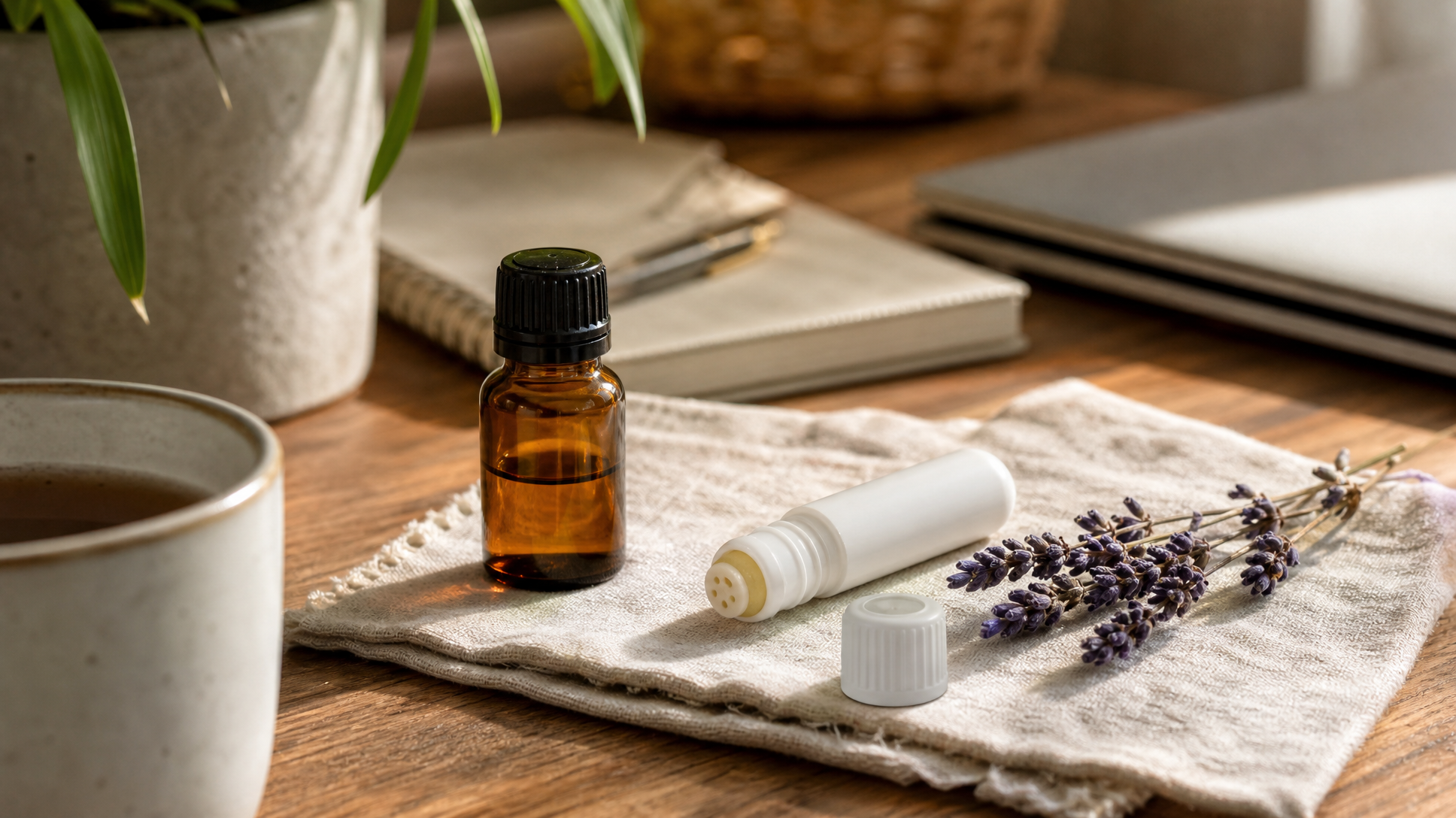
- Aromatherapy at your desk: Essential oils like lavender and peppermint are commonly used for stress and tension relief. A small personal diffuser or an inhaler stick keeps it contained to your workspace without bothering colleagues. If you're curious about incorporating this into your routine, the aromatherapy collection is worth a look.
What Alternative Therapy Options Are Actually Relevant Here
Alternative therapy gets lumped in with serious wellness routines, but some of it translates well to everyday stress management. A few categories worth knowing about:
Acupuncture: Not something you can do at your desk, obviously — but if you're dealing with chronic work stress that's affecting your sleep or causing recurring physical tension, regular acupuncture sessions are used by many people as part of a broader management approach. It's worth exploring if you haven't considered it.
Ayurvedic and herbal options: Adaptogenic herbs like ashwagandha are widely discussed in the context of stress response. These fall under the broader alternative medicine category, and if you're considering them, it's worth reading the label carefully and, ideally, checking with your doctor — especially if you're on other medications.
Homeopathic remedies: Some people use homeopathic stress formulas as a low-risk complement to other approaches. The evidence base is limited, so go in with realistic expectations — but for some, they're a useful part of a broader toolkit.
The honest note here: alternative therapies work best as part of a consistent routine, not as emergency fixes on a bad day. If you're curious about what's available, the Ayurveda collection covers several options worth exploring.
OTC Options Worth Knowing About (With Honest Caveats)
When stress tips into a tension headache or muscle pain that's genuinely interfering with your ability to work, OTC pain relievers are a reasonable short-term tool. They're not a stress management strategy on their own — but pretending they have no place in a practical toolkit isn't honest either.
What they're suited for: managing the physical symptoms that stress produces (headaches, muscle tension, general discomfort) so you can function during the day. What they're not suited for: the underlying stress itself, or regular use as a coping mechanism. If you're reaching for pain relief multiple times a week because of stress-related symptoms, that's a signal worth paying attention to — not just a dosing problem.
Sleep is also worth mentioning here. Chronic work stress and poor sleep reinforce each other in a pretty vicious loop. If stress is affecting your sleep quality, that's worth addressing directly rather than just managing the daytime symptoms. Our post on natural sleep aids without melatonin covers some options if you're looking for a starting point.
Building a Toolkit That Actually Sticks
The reason most stress management advice doesn't stick isn't that people are lazy — it's that the techniques require more friction than the stress does. The fix is reducing friction to near zero.
Think about it this way: if your breathing technique requires you to find a quiet room, or your aromatherapy setup takes five minutes to assemble, you won't use it when you need it most. The tools that work are the ones already on your desk or already in your muscle memory.
A practical starting point:
- Pick one breathing technique and practice it on a low-stress day so it's automatic when you actually need it.
- Keep one physical tension tool within arm's reach — a small heat patch, an acupressure ring, an inhaler stick, whatever you'll actually use.
- Build in one two-minute movement or stretch break in the afternoon, even if it's just standing up and rolling your shoulders.
- Address sleep and recovery separately — daytime stress management and nighttime recovery are two different problems, and solving one helps the other.
You don't need all of this at once. Start with the one thing that addresses your most common symptom — whether that's tension headaches, tight shoulders, or a racing mind at 3 p.m. — and build from there.
If you're ready to put together a practical at-desk toolkit, explore Medistoreweb's wellness and alternative therapy range — from aromatherapy to acupuncture supplies to everyday wellness essentials, it's a good place to start building something that actually fits your day.
Frequently Asked Questions
What's the fastest stress relief technique I can do at my desk without anyone noticing?
Box breathing is probably the most effective option that's completely invisible. Inhale for four counts, hold for four, exhale for four, hold for four — repeat a few times. It takes under two minutes and you can do it mid-meeting. Acupressure on the LI4 point (the web between thumb and index finger) is another option that looks like nothing from the outside.
Can aromatherapy actually help with work stress, or is it just a nice smell?
There's a real physiological basis for it — scent is processed by the limbic system, which is closely tied to emotion and stress response. Lavender in particular has been studied in the context of anxiety and relaxation. It's not a cure, but for mild tension during the day, a personal inhaler stick or small desk diffuser can take the edge off in a way that's worth trying. Keep expectations realistic and use it as one tool among several, not the whole strategy.
Is it okay to take OTC pain relievers regularly for stress headaches?
Occasional use for a genuine tension headache is what OTC pain relievers are designed for. Regular or daily use is a different matter — both because of the underlying signal it sends about your stress levels, and because frequent use of some pain relievers can actually contribute to rebound headaches over time. If you're reaching for them multiple times a week, it's worth talking to a doctor about what's driving the headaches rather than just managing the symptom.
How do I know if my work stress is serious enough to need more than self-help techniques?
If stress is consistently affecting your sleep, your physical health (frequent headaches, digestive issues, getting sick more often), your ability to concentrate, or your mood at home — those are signs it's worth talking to a healthcare provider. Self-help techniques are genuinely useful for everyday stress, but they're not a substitute for professional support when the load is heavier than that. There's no threshold you have to hit before it's "serious enough" to ask for help.